Wax Warmers: Types, Uses, and Care
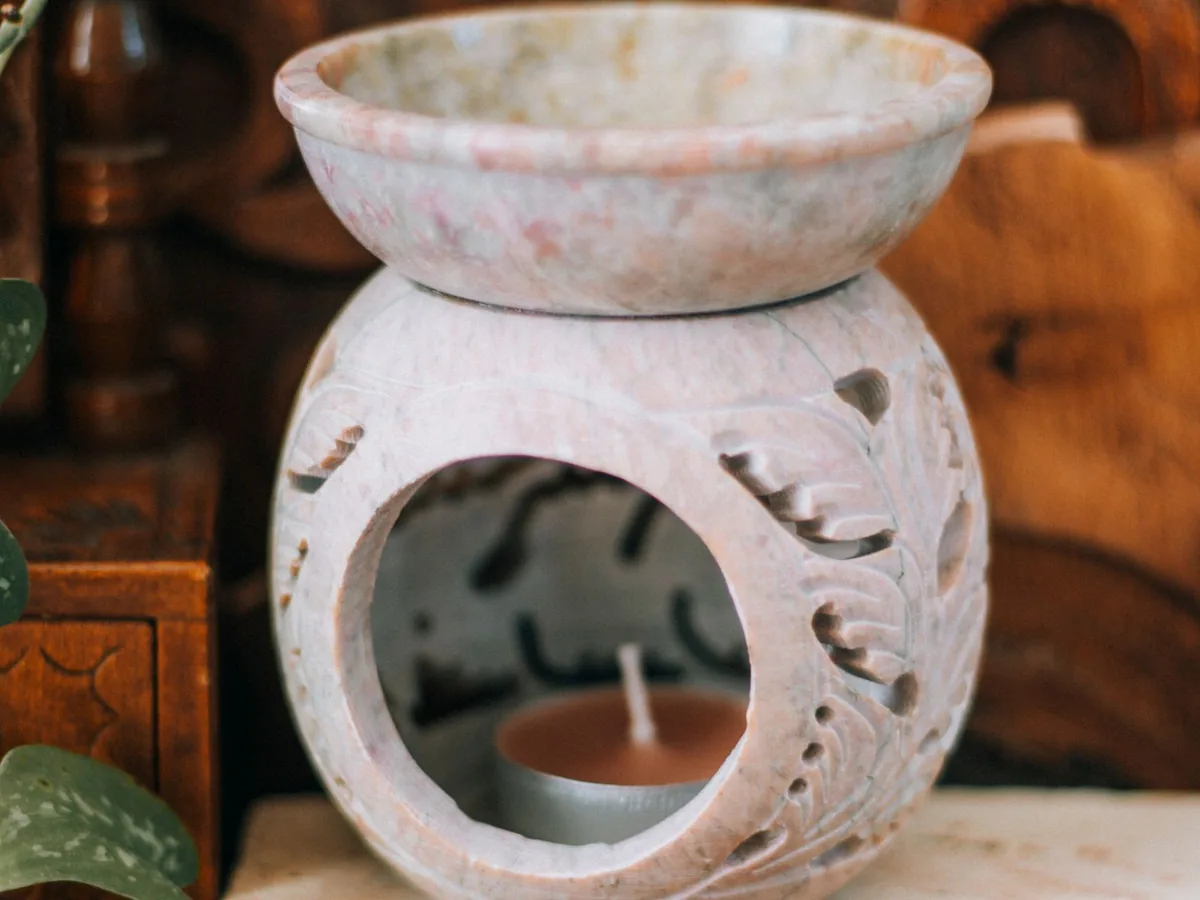
A wax warmer, also called a fragrance burner, is the candle-powered diffuser that turns a wax melt into room scent: a lower chamber holds the tealight, the upper dish holds the wax to be melted. No motor, no power socket: just ceramic and a small flame.
Precisely because the mechanism is so simple, quality comes down to proportions and material: the distance between flame and dish, the air opening, the thickness of the ceramic. Those are the three criteria of this guide.
Material: why ceramic dominates
Glazed ceramic is the reference material for three practical reasons: it spreads heat evenly and avoids hot spots, it does not absorb fragrance oils as long as the glaze is intact, and it wipes clean once the wax is solid. Glass is the scenic alternative, with the flame in view, but heats less evenly; metal heats fast and overheats just as fast. For everyday use, white ceramic, as in the Italian porcelain tradition, remains the soundest choice.
The proportions that decide performance
| Parameter | Practical reference | If it is wrong |
|---|---|---|
| Flame-to-dish distance | About 8-10 cm | Too little: overheated wax, fragrance burned off fast. Too much: the wax never fully melts |
| Air opening | A wide side window or piercing | The flame breathes badly, dies out or soots |
| Tealight chamber | Room for a standard 38 mm tealight | Maxi formats do not fit or overheat the dish |
| Dish capacity | One whole melt with half a centimetre to spare | A brimful dish means wax runs down the ceramic |
The right tealight is part of the design: a standard one, which per the Wikipedia entry measures about 38 mm across and puts out around 32 watts of heat, is the "engine" these objects are sized for. Larger or doubled-up candles push the dish out of spec.
Safety: the same rules apply here
A real flame burns inside a warmer, so the National Candle Association rules apply in full: never unattended, at least 12 inches from curtains and anything flammable, on a stable heat-resistant surface, away from drafts and out of reach of children and pets. Two format-specific points: never move the warmer while the wax is liquid, and never add water or oils directly over the flame. On the regulatory side, fire safety of indoor candles in Europe is specified by EN 15493, updated in 2026.
Style and colour: choosing without regrets
Looks matter, but after proportions. White and cream tones fit any room and show at a glance when the dish needs emptying; pierced designs cast patterns of light and improve airflow; closed shapes hold heat and need a closer look at the air opening. For a bedroom, prefer a model with a screen that softens the flame's light. For the wax that goes on top, start from scented wax melts and the fragrance guide; for the candles underneath, the white tealights page covers sizes and burn times.
Frequently asked questions about wax warmers
What is the difference between electric and tealight warmers?
The tealight model heats the dish with a small candle: a live flame, no cable, free placement, in exchange for the constant supervision any flame demands. The electric model, with a plate or bulb, removes the flame and lives next to a socket; it often runs hotter, and a hotter dish evaporates the oils faster. For a supervised evening ritual the candle model remains the reference; electric belongs where a flame cannot.
Can I leave a wax warmer on overnight?
No. A real flame burns inside, and the first NCA rule, never leave a burning candle unattended, has no overnight exception. There is also a rhythm reference: CandleScience defines a candle's standard burn cycle as 4 hours and warns against longer unbroken sessions. Close the session by putting out the tealight: the wax sets in the dish and picks up again next time.
How do I remove leftover wax from a warmer?
Cold: with the wax solid and the ceramic cool, light pressure on the disc's edge releases it in one piece; if it resists, ten minutes in the fridge make it contract and let go on its own. No metal scrapers, which scratch the glaze, and no boiling water, which risks thermal shock to the ceramic.